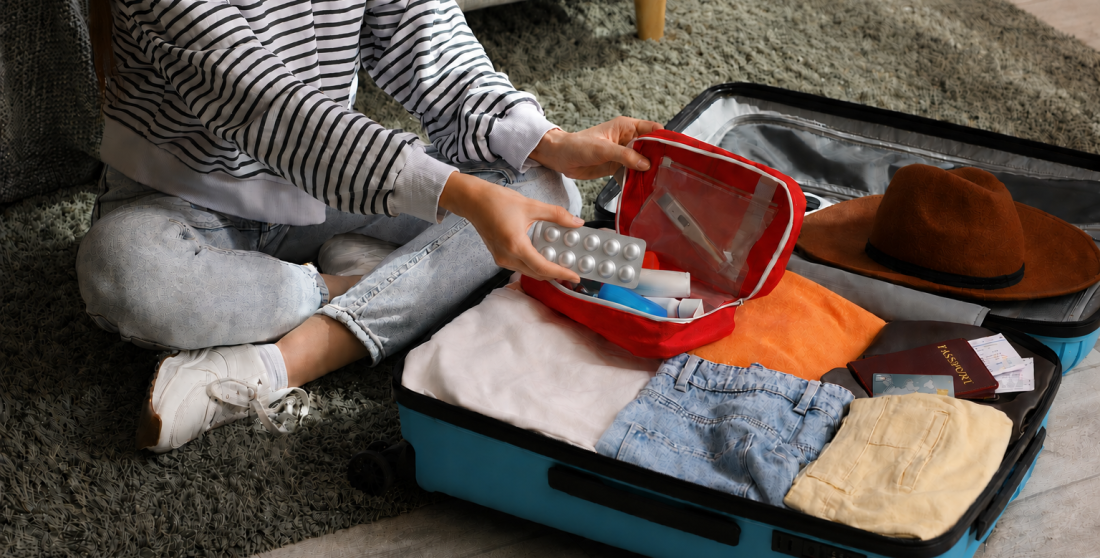
Preparing your prescription before departure¹˒²
Your original prescription is the key document you should always carry with you, including for medications that do not require a prescription. It can help facilitate discussions with customs authorities or healthcare professionals at your destination if needed. Useful recommendations before travelling:
- Check that your prescription is recent and clearly legible.
- If possible, use a prescription that includes the International Nonproprietary Name (INN) of the medications rather than only their brand names.
- Have your prescription translated into English (or the language of the destination country) when travelling outside French-speaking regions.
- Contact the embassy or consulate of your destination country in advance, as each country has its own regulations regarding medications.
Packing your medications properly²˒³
- Keep your medications in their original packaging, together with the patient information leaflet.
- Carry your treatment in your hand luggage rather than checked baggage to avoid the risk of loss or exposure to extreme temperatures.
- Bring an amount that covers the entire duration of your trip, with an additional safety margin in case of unexpected delays.
- Use an insulated travel pouch for medications that are sensitive to heat.
Special considerations for liquid medications and treatments subject to specific regulations¹˒³
Liquid medications required for treatment can generally be carried in hand luggage beyond the standard liquid restrictions (the usual 100 ml limit), subject to security screening requirements and upon presentation of appropriate supporting documentation. For certain medications that are subject to specific regulations, a certificate or special authorization may be required depending on the destination country. Travellers should check the applicable requirements with the French National Agency for the Safety of Medicines and Health Products (ANSM) and the authorities of the destination country.
References:
(1) French National Agency for the Safety of Medicines and Health Products (ANSM) – Travelling with My Medications. Available at: https://ansm.sante.fr/vos-demarches/patient/voyager-avec-mes-medicaments (Accessed on August 10, 2026)
(2) French Customs Authority (Direction Générale des Douanes et Droits Indirects) – Travelling with Medications. Available at: https://www.douane.gouv.fr/demarche/vous-voyagez-avec-des-medicaments (Accessed on August 10, 2026)
(3) French Health Insurance (Ameli) – How to Prepare a Travel Medication Kit. Available at: https://www.ameli.fr/assure/sante/medicaments/medicaments-et-situation-de-vie/preparer-trousse-medicaments-voyage (Accessed on August 10, 2026)